在本篇文章中,我们学习一下函数式编程的中非常重要的Map、Reduce、Filter的三种操作,这三种操作可以让我们非常方便灵活地进行一些数据处理——我们的程序中大多数情况下都是在到倒腾数据,尤其对于一些需要统计的业务场景,Map/Reduce/Filter是非常通用的玩法。下面先来看几个例子:
基本示例
Map示例
下面的程序代码中,我们写了两个Map函数,这两个函数需要两个参数,
- 一个是字符串数组
[]string,说明需要处理的数据一个字符串 - 另一个是一个函数
func(s string) string或func(s string) int
func MapStrToStr(arr []string, fn func(s string) string) []string {
    var newArray = []string{}
    for _, it := range arr {
        newArray = append(newArray, fn(it))
    }
    return newArray
}

func MapStrToInt(arr []string, fn func(s string) int) []int {
    var newArray = []int{}
    for _, it := range arr {
        newArray = append(newArray, fn(it))
    }
    return newArray
}
整个Map函数运行逻辑都很相似,函数体都是在遍历第一个参数的数组,然后,调用第二个参数的函数,然后把其值组合成另一个数组返回。
于是我们就可以这样使用这两个函数:
var list = []string{"Hao", "Chen", "MegaEase"}

x := MapStrToStr(list, func(s string) string {
    return strings.ToUpper(s)
})
fmt.Printf("%v\n", x)
//["HAO", "CHEN", "MEGAEASE"]

y := MapStrToInt(list, func(s string) int {
    return len(s)
})
fmt.Printf("%v\n", y)
//[3, 4, 8]
我们可以看到,我们给第一个 MapStrToStr() 传了函数做的是 转大写,于是出来的数组就成了全大写的,给MapStrToInt() 传的是算其长度,所以出来的数组是每个字符串的长度。
我们再来看一下Reduce和Filter的函数是什么样的。
Reduce:
func Reduce(arr []string, fn func(s string) int) int {
    sum := 0
    for _, it := range arr {
        sum += fn(it)
    }
    return sum
}

var list = []string{"Hao", "Chen", "MegaEase"}

x := Reduce(list, func(s string) int {
    return len(s)
})
fmt.Printf("%v\n", x)
// 15
Filter:
func Filter(arr []int, fn func(n int) bool) []int {
    var newArray = []int{}
    for _, it := range arr {
        if fn(it) {
            newArray = append(newArray, it)
        }
    }
    return newArray
}

var intset = []int{1, 2, 3, 4, 5, 6, 7, 8, 9, 10}
out := Filter(intset, func(n int) bool {
   return n%2 == 1
})
fmt.Printf("%v\n", out)

out = Filter(intset, func(n int) bool {
    return n > 5
})
fmt.Printf("%v\n", out)
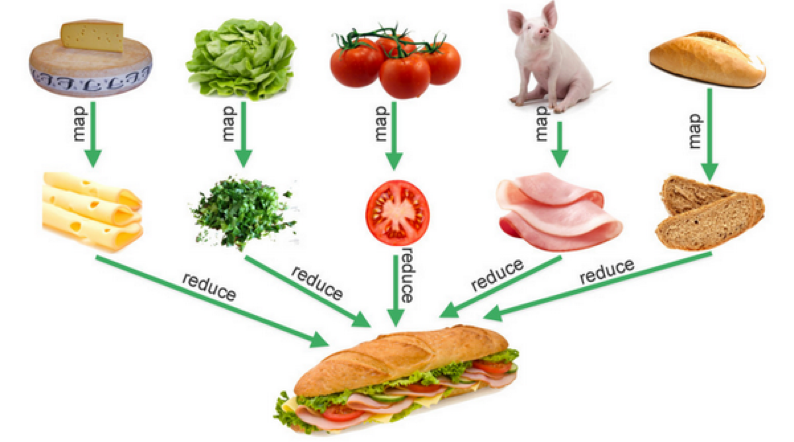
下图是一个比喻,其非常形象地说明了Map-Reduce是的业务语义,其在数据处理中非常有用。
业务示例
通过上面的一些示例,你可能有一些明白,Map/Reduce/Filter只是一种控制逻辑,真正的业务逻辑是在传给他们的数据和那个函数来定义的。是的,这是一个很经典的“业务逻辑”和“控制逻辑”分离解耦的编程模式,Golang中常用的sort包中也采用了这种设计模式实现了sort.Slice()方法。下面我们来看一个有业务意义的代码,来让大家强化理解一下什么叫“控制逻辑”与业务逻辑分离。
首先,我们定义一个员工对象,以及一些数据:
type Employee struct {
    Name     string
    Age      int
    Vacation int
    Salary   int
}

var list = []Employee{
    {"Hao", 44, 0, 8000},
    {"Bob", 34, 10, 5000},
    {"Alice", 23, 5, 9000},
    {"Jack", 26, 0, 4000},
    {"Tom", 48, 9, 7500},
    {"Marry", 29, 0, 6000},
    {"Mike", 32, 8, 4000},
}
然后,我们有如下的几个函数:
func EmployeeCountIf(list []Employee, fn func(e *Employee) bool) int {
    count := 0
    for i, _ := range list {
        if fn(&list[i]) {
            count += 1
        }
    }
    return count
}

func EmployeeFilterIn(list []Employee, fn func(e *Employee) bool) []Employee {
    var newList []Employee
    for i, _ := range list {
        if fn(&list[i]) {
            newList = append(newList, list[i])
        }
    }
    return newList
}

func EmployeeSumIf(list []Employee, fn func(e *Employee) int) int {
    var sum = 0
    for i, _ := range list {
        sum += fn(&list[i])
    }
    return sum
}
简单说明一下:
EmployeeConutIf和EmployeeSumIf分别用于统满足某个条件的个数或总数。它们都是Filter + Reduce的语义。EmployeeFilterIn就是按某种条件过虑。就是Fitler的语义。
于是我们就可以有如下的代码:
1)统计有多少员工大于40岁
old := EmployeeCountIf(list, func(e *Employee) bool {
    return e.Age > 40
})
fmt.Printf("old people: %d\n", old)
//old people: 2
2)统计有多少员工薪水大于6000
high_pay := EmployeeCountIf(list, func(e *Employee) bool {
    return e.Salary >= 6000
})
fmt.Printf("High Salary people: %d\n", high_pay)
//High Salary people: 4
3)列出有没有休假的员工
no_vacation := EmployeeFilterIn(list, func(e *Employee) bool {
    return e.Vacation == 0
})
fmt.Printf("People no vacation: %v\n", no_vacation)
//People no vacation: [{Hao 44 0 8000} {Jack 26 0 4000} {Marry 29 0 6000}]
4)统计所有员工的薪资总和
total_pay := EmployeeSumIf(list, func(e *Employee) int {
    return e.Salary
})

fmt.Printf("Total Salary: %d\n", total_pay)
//Total Salary: 43500
5)统计30岁以下员工的薪资总和
younger_pay := EmployeeSumIf(list, func(e *Employee) int {
    if e.Age < 30 {
        return e.Salary
    }
    return 0
})
泛型Map-Reduce
我们可以看到,上面的Map-Reduce都因为要处理数据的类型不同而需要写出不同版本的Map-Reduce,虽然他们的代码看上去是很类似的。所以,这里就要带出来泛型编程了,目前的Go语言的泛型只能用 interface{} + reflect来完成。
下面我们来看一下一个非常简单不作任何类型检查的泛型的Map函数怎么写:
func Map(data interface{}, fn interface{}) []interface{} {
    vfn := reflect.ValueOf(fn)
    vdata := reflect.ValueOf(data)
    result := make([]interface{}, vdata.Len())

    for i := 0; i < vdata.Len(); i++ {
        result[i] = vfn.Call([]reflect.Value{vdata.Index(i)})[0].Interface()
    }
    return result
}
上面的代码中,
- 通过
reflect.ValueOf()来获得interface{}的值,其中一个是数据vdata,另一个是函数vfn, - 然后通过
vfn.Call()方法来调用函数,通过[]refelct.Value{vdata.Index(i)}来获得数据。
于是,我们就可以有下面的代码——不同类型的数据可以使用相同逻辑的Map()代码:
square := func(x int) int {
  return x * x
}
nums := []int{1, 2, 3, 4}

squared_arr := Map(nums,square)
fmt.Println(squared_arr)
//[1 4 9 16]


upcase := func(s string) string {
  return strings.ToUpper(s)
}
strs := []string{"Hao", "Chen", "MegaEase"}
upstrs := Map(strs, upcase);
fmt.Println(upstrs)
//[HAO CHEN MEGAEASE]
但是因为反射是运行时的事,所以,如果类型什么出问题的话,就会有运行时的错误。
健壮版的Generic Map
所以,如果要写一个健壮的程序,对于这种用interface{} 的“过度泛型”,就需要我们自己来做类型检查。下面是一个有类型检查的Map代码(分为是否就地计算两个版本):
func Transform(slice, function interface{}) interface{} {
  return transform(slice, function, false)
}

func TransformInPlace(slice, function interface{}) interface{} {
  return transform(slice, function, true)
}

func transform(slice, function interface{}, inPlace bool) interface{} {

  //check the <code data-enlighter-language="raw" class="EnlighterJSRAW">slice</code> type is Slice
  sliceInType := reflect.ValueOf(slice)
  if sliceInType.Kind() != reflect.Slice {
    panic("transform: not slice")
  }

  //check the function signature
  fn := reflect.ValueOf(function)
  elemType := sliceInType.Type().Elem()
  if !verifyFuncSignature(fn, elemType, nil) {
    panic("trasform: function must be of type func(" + sliceInType.Type().Elem().String() + ") outputElemType")
  }

  sliceOutType := sliceInType
  if !inPlace {
    sliceOutType = reflect.MakeSlice(reflect.SliceOf(fn.Type().Out(0)), sliceInType.Len(), sliceInType.Len())
  }
  for i := 0; i < sliceInType.Len(); i++ {
    sliceOutType.Index(i).Set(fn.Call([]reflect.Value{sliceInType.Index(i)})[0])
  }
  return sliceOutType.Interface()

}

func verifyFuncSignature(fn reflect.Value, types ...reflect.Type) bool {

  //Check it is a funciton
  if fn.Kind() != reflect.Func {
    return false
  }
  // NumIn() - returns a function type's input parameter count.
  // NumOut() - returns a function type's output parameter count.
  if (fn.Type().NumIn() != len(types)-1) || (fn.Type().NumOut() != 1) {
    return false
  }
  // In() - returns the type of a function type's i'th input parameter.
  for i := 0; i < len(types)-1; i++ {
    if fn.Type().In(i) != types[i] {
      return false
    }
  }
  // Out() - returns the type of a function type's i'th output parameter.
  outType := types[len(types)-1]
  if outType != nil && fn.Type().Out(0) != outType {
    return false
  }
  return true
}
上面的代码一下子就复杂起来了,可见,复杂的代码都是在处理异常的地方。我不打算Walk through 所有的代码,别看代码多,但是还是可以读懂的,下面列几个代码中的要点:
- 代码中没有使用Map函数,因为和数据结构和关键有含义冲突的问题,所以使用
Transform,这个来源于 C++ STL库中的命名。 - 有两个版本的函数,一个是返回一个全新的数组 –
Transform(),一个是“就地完成” –TransformInPlace() - 在主函数中,用
Kind()方法检查了数据类型是不是 Slice,函数类型是不是Func - 检查函数的参数和返回类型是通过
verifyFuncSignature()来完成的,其中:NumIn()– 用来检查函数的“入参”-
NumOut()用来检查函数的“返回值”
- 如果需要新生成一个Slice,会使用
reflect.MakeSlice()来完成。
好了,有了上面的这段代码,我们的代码就很可以很开心的使用了:
可以用于字符串数组:
list := []string{"1", "2", "3", "4", "5", "6"}
result := Transform(list, func(a string) string{
    return a +a +a
})
//{"111","222","333","444","555","666"}
可以用于整形数组:
list := []int{1, 2, 3, 4, 5, 6, 7, 8, 9}
TransformInPlace(list, func (a int) int {
  return a*3
})
//{3, 6, 9, 12, 15, 18, 21, 24, 27}
可以用于结构体:
var list = []Employee{
    {"Hao", 44, 0, 8000},
    {"Bob", 34, 10, 5000},
    {"Alice", 23, 5, 9000},
    {"Jack", 26, 0, 4000},
    {"Tom", 48, 9, 7500},
}

result := TransformInPlace(list, func(e Employee) Employee {
    e.Salary += 1000
    e.Age += 1
    return e
})
同样,泛型版的 Reduce 代码如下:
func Reduce(slice, pairFunc, zero interface{}) interface{} {
  sliceInType := reflect.ValueOf(slice)
  if sliceInType.Kind() != reflect.Slice {
    panic("reduce: wrong type, not slice")
  }

  len := sliceInType.Len()
  if len == 0 {
    return zero
  } else if len == 1 {
    return sliceInType.Index(0)
  }

  elemType := sliceInType.Type().Elem()
  fn := reflect.ValueOf(pairFunc)
  if !verifyFuncSignature(fn, elemType, elemType, elemType) {
    t := elemType.String()
    panic("reduce: function must be of type func(" + t + ", " + t + ") " + t)
  }

  var ins [2]reflect.Value
  ins[0] = sliceInType.Index(0)
  ins[1] = sliceInType.Index(1)
  out := fn.Call(ins[:])[0]

  for i := 2; i < len; i++ {
    ins[0] = out
    ins[1] = sliceInType.Index(i)
    out = fn.Call(ins[:])[0]
  }
  return out.Interface()
}
泛型版的 Filter 代码如下:
func Filter(slice, function interface{}) interface{} {
  result, _ := filter(slice, function, false)
  return result
}

func FilterInPlace(slicePtr, function interface{}) {
  in := reflect.ValueOf(slicePtr)
  if in.Kind() != reflect.Ptr {
    panic("FilterInPlace: wrong type, " +
      "not a pointer to slice")
  }
  _, n := filter(in.Elem().Interface(), function, true)
  in.Elem().SetLen(n)
}

var boolType = reflect.ValueOf(true).Type()

func filter(slice, function interface{}, inPlace bool) (interface{}, int) {

  sliceInType := reflect.ValueOf(slice)
  if sliceInType.Kind() != reflect.Slice {
    panic("filter: wrong type, not a slice")
  }

  fn := reflect.ValueOf(function)
  elemType := sliceInType.Type().Elem()
  if !verifyFuncSignature(fn, elemType, boolType) {
    panic("filter: function must be of type func(" + elemType.String() + ") bool")
  }

  var which []int
  for i := 0; i < sliceInType.Len(); i++ {
    if fn.Call([]reflect.Value{sliceInType.Index(i)})[0].Bool() {
      which = append(which, i)
    }
  }

  out := sliceInType

  if !inPlace {
    out = reflect.MakeSlice(sliceInType.Type(), len(which), len(which))
  }
  for i := range which {
    out.Index(i).Set(sliceInType.Index(which[i]))
  }

  return out.Interface(), len(which)
}
使用反射来做这些东西,会有一个问题,那就是代码的性能会很差。所以,上面的代码不能用于你需要高性能的地方。